
Succession Certificate
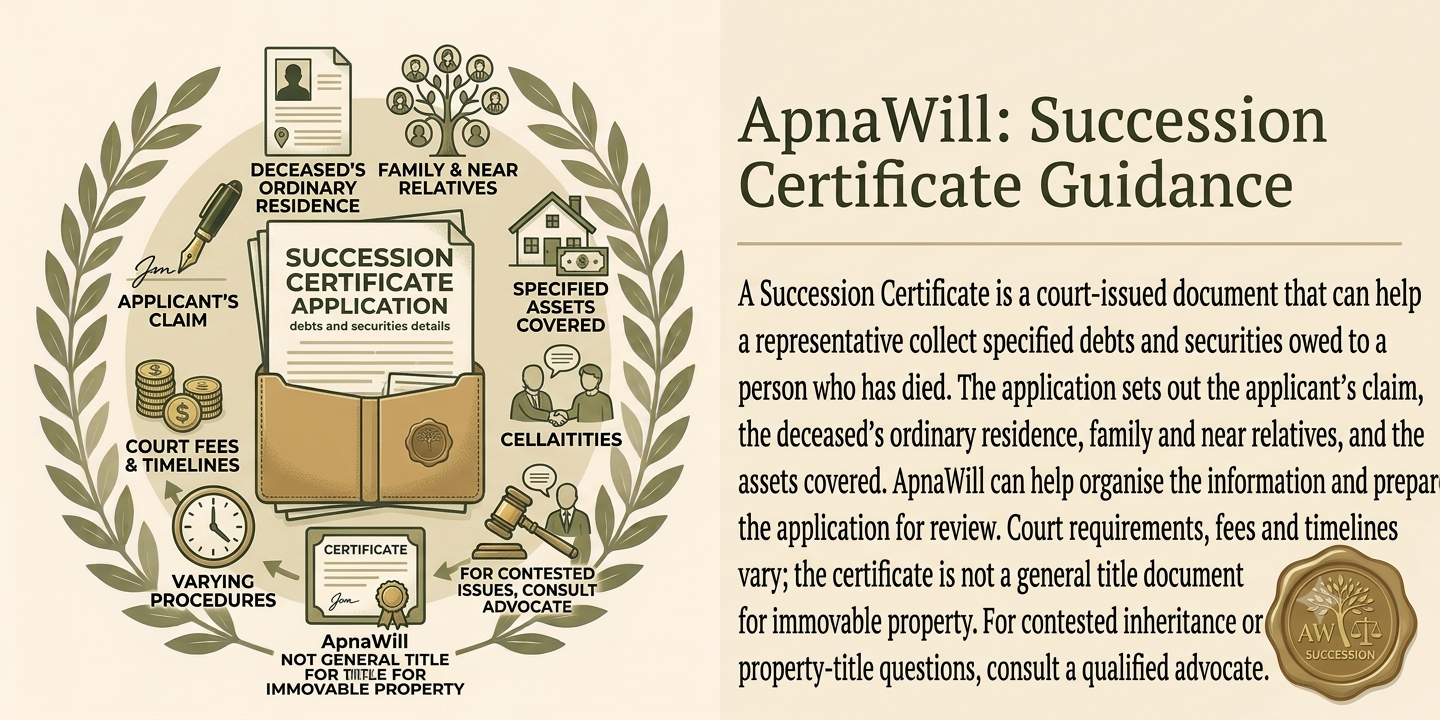
A Succession Certificate is a court-issued document that can help a representative collect specified debts and securities owed to a person who has died. The application sets out the applicant’s claim, the deceased’s ordinary residence, family and near relatives, and the assets covered. ApnaWill can help organise the information and prepare the application for review. Court requirements, fees and timelines vary; the certificate is not a general title document for immovable property. For contested inheritance or property-title questions, consult a qualified advocate.
Enquiry form
Tell us where the deceased ordinarily lived, which debts or securities need attention, and whether there are other heirs or an existing court grant. ApnaWill can follow up using the contact details you provide.
Succession Certificate questions, answered.
Understand when a certificate may be requested, what it covers, who can apply, expected fees and timing, and which records to gather. Costs and court procedures depend on the location, assets and circumstances.
Ask ApnaWill ↗What does a Succession Certificate allow a family to do?
A court may issue a Succession Certificate for specified debts and securities left by someone who has died. It can authorise its holder to collect those items or exercise the powers stated in the certificate. It does not settle ownership of every asset in the estate.
Is a certificate needed for every asset after a death?
No. It is generally used for debts and securities named in the certificate, rather than as a general document for transferring a home or land. Whether an institution asks for one can depend on the asset, nomination, other court grants and the applicable rules.
When might a family be asked to obtain one?
A bank, company or other debtor may request court authority before releasing or dealing with specified financial claims. Families may encounter this where the institution needs proof of who can act, but a certificate is not automatically required in every case where someone dies without a Will.
Does a Will mean a Succession Certificate is unnecessary?
Not in every situation. The appropriate document can depend on the Will, the asset, applicable law and the institution’s process. Probate or letters of administration may be relevant in some cases. Check the correct route for the particular estate before applying.
Who can apply if there are several legal heirs?
A person claiming an interest may petition the court and should disclose the deceased’s family or near relatives, their residences and the basis of the claim. The court considers the circumstances and any competing applicants. A certificate granted to one person does not by itself erase other heirs’ legal rights.
What can affect the cost of a Succession Certificate?
There is no single all-India price. Court fees and filing requirements can vary by State and by the debts or securities listed; professional fees, document work and case complexity may add to the total. The court may also require a bond or sureties. A reliable estimate needs the location and asset details.
How long could the application take?
Timing depends on the court, how complete the petition is, the notice process and whether anyone objects. Because these factors differ from case to case, a fixed timeline cannot be promised. A local review of the documents and court requirements can help set a more realistic expectation.
Which documents should we gather before applying?
Start with the death certificate, the applicant’s identity and contact details, information about the deceased’s usual residence, details of close relatives, and records identifying each debt or security. Any Will, nomination, prior court order or consent may also matter. The court’s exact checklist can vary by location.