
A practical estate planning guide for Indian households
Estate planning helps you organize what you own, clarify your wishes, and make important records easier for loved ones to find. Use this checklist as a starting point and adapt it to your family, assets, and applicable law.
Five principles to keep in view
A useful plan is clear, coordinated, secure, and reviewed when life changes.
Planning is for every household
Estate planning matters if you manage property, savings, investments, insurance, debts, or care for dependents. It is not limited to the ultra-wealthy.
Start with clear instructions
A carefully prepared Will can set out who should receive identified assets and who should help administer your estate. Formalities depend on the law that applies to you.
Check nominations by asset type
A nominee can help an institution process a claim, but the effect of nomination varies across assets. For bank deposits, RBI directions describe payment to a nominee as being received as trustee for legal heirs.
Keep records findable
Store deeds, account details, identity documents, nominations, and legal papers in a secure, indexed place. Tell your executor and a trusted family member how to locate them.
Review after life changes
Marriage, separation, children, property or business changes, bereavement, and a move overseas can all be reasons to revisit your plan.
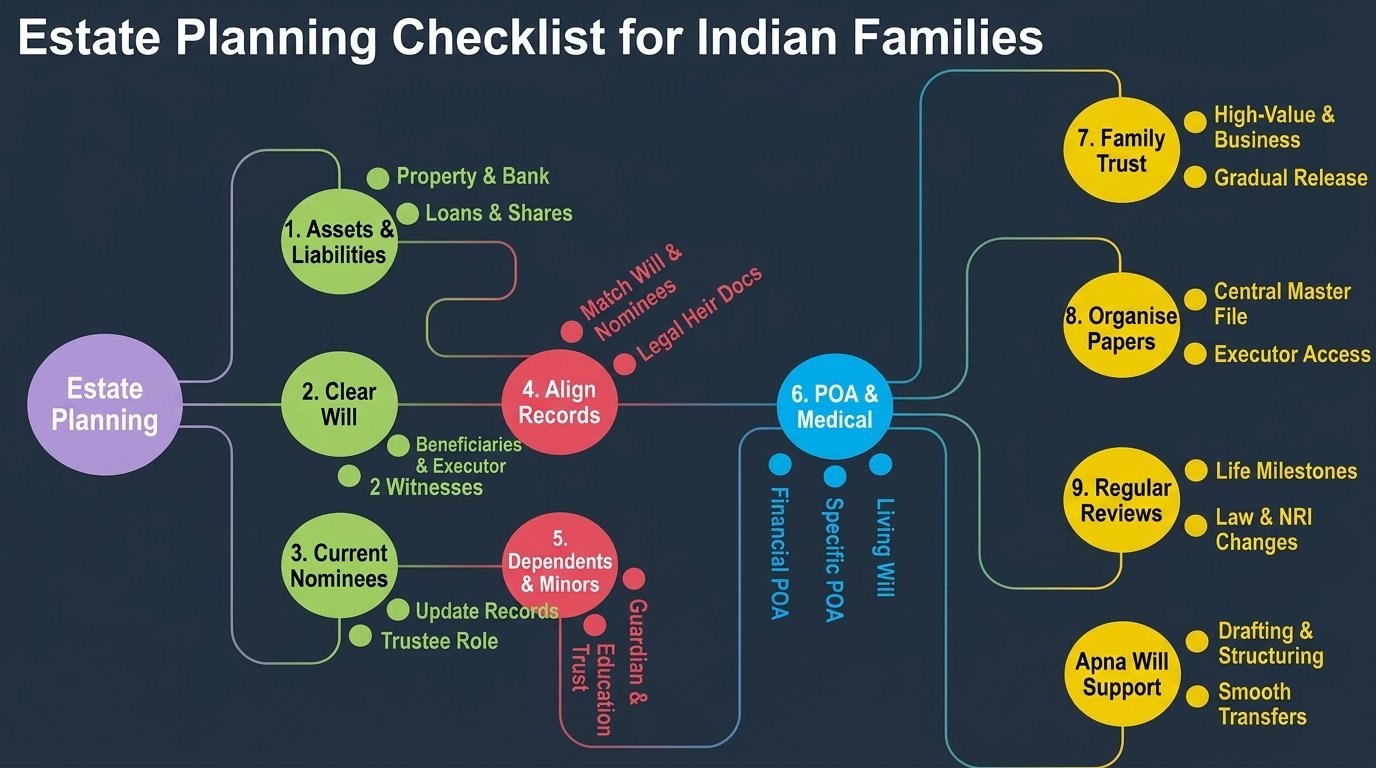
Practical estate planning for your household
Work through these steps at your own pace. You do not need to complete every document at once; start by making a clear inventory and identifying where you need professional guidance.
Step 1 · Catalog assets and liabilities
Before deciding how wealth should be divided, build a complete inventory of what you own and owe. Without an accurate record, assets may be overlooked even when a Will exists.
Your ledger can include:
- Real estate: homes, flats, agricultural or other land, and commercial property.
- Cash and banking: savings accounts, fixed deposits, and safe-deposit lockers.
- Investments and retirement savings: mutual funds, shares, demat holdings, EPF, NPS, and insurance policies.
- Valuables: gold, jewellery, vehicles, and significant personal items.
- Business interests: company shares, partnership stakes, and family enterprise assets.
- Liabilities: home loans, mortgages, personal debts, guarantees, and other outstanding obligations.
Step 2 · Prepare a clear Will
For many Indian families, a clear Will is an important part of planning for how property should pass after death.
A Will commonly records:
- The full legal name and details of the person making it (the testator).
- Identifying details of the chosen beneficiaries.
- Clear, asset-specific allocation instructions.
- A trusted executor to administer the estate.
- A guardian for minor children, where appropriate.
- The testator’s signature and date.
- Attestation by the witnesses required under the applicable law.
Step 3 · Review nominations
A nomination can help an institution identify whom it may pay or give access to after a customer’s death. It does not have the same legal effect for every kind of asset, so check the rules for each account or policy and coordinate nominations with your Will.
Review nominations for:
- Bank accounts and fixed deposits
- Life insurance policies
- Mutual fund folios
- Demat accounts and shareholdings
- EPF, NPS, and pension arrangements
- Lockers and safe-custody items
Step 4 · Align records and intentions
Compare institutional records with your Will so outdated information does not create avoidable delay or confusion. For example, a Will may leave an account to a spouse while an old nominee remains on record. The bank may settle the account with the recorded nominee under the rules that apply, while the spouse’s inheritance claim may need to be resolved separately.
To reduce mismatches:
- Compare nominee records with the beneficiaries named in your Will.
- Update outdated nominations after marriage, separation, a birth, or a bereavement.
- Describe asset-specific distributions clearly in your Will.
- Keep legal-heir and identity documents current where relevant.
- Make sure family members understand that nomination and inheritance are not always the same thing.
Step 5 · Plan for children and dependents
Estate planning also means considering the people who rely on you: minor children, elderly parents, or dependents with special needs.
Consider measures such as:
- Naming a primary and backup guardian for minor children.
- Setting aside funds for dependent parents or relatives.
- Planning long-term support for a disabled or vulnerable family member.
- Budgeting for education, healthcare, and ordinary living costs.
- Using staged or milestone-based distributions where a lump sum may not be suitable.
Step 6 · Consider lifetime directives
A plan can cover periods when you are alive but unable to manage particular affairs because of illness, age, or extended travel. The scope and formal requirements for a Power of Attorney depend on the document, purpose, and state or transaction involved.
Ask a qualified adviser about:
- General financial Power of Attorney: authority for a trusted representative to handle specified financial, property, or legal matters.
- Specific Power of Attorney: limited authority for a defined act, such as a particular property transaction.
- Advance Medical Directive: instructions about specified future medical treatment, subject to the Supreme Court’s framework and applicable procedures.
Step 7 · Assess whether a family trust fits
A private family trust is not necessary for every household. A clear Will, up-to-date nominations, and organized records may be enough for a straightforward estate.
Discuss whether a trust may be suitable if your estate includes high-value property or complex investments; a family-run business; dependents who need continuing financial oversight; staged distributions across milestones or generations; possible family disputes; or NRI and cross-border assets. Professional trustees may also be an option.
Trusts bring setup and ongoing responsibilities that can include drafting costs, stamp duty, registration, trustee governance, accounting, and tax filings. Weigh the control and administration they provide against those obligations, and establish one only when it fits your needs.
Step 8 · Organize important documents
A plan is only useful if the right people can locate the supporting papers. Keep an indexed file in a secure, accessible place, and decide who should know how to find it.
Documents to organize may include:
- The original Will and any later codicils
- Property title deeds, sale agreements, and mutation records
- Bank passbooks, statements, and fixed-deposit receipts
- Mutual-fund statements, share certificates, and demat records
- Insurance policy documents
- EPF, NPS, and pension records
- Loan agreements, mortgage deeds, and no-objection certificates
- Business incorporation papers, share certificates, and partnership deeds
- PAN, passport, and other identity records
- Birth, marriage, death, and legal-heir certificates
- Executed Powers of Attorney and any advance medical directive
- Trust deeds, if applicable
Step 9 · Revisit your plan regularly
Estate planning is an ongoing task. As your wealth, family circumstances, or applicable rules change, review your documents and records.
Consider a review after:
- Marriage, separation, or divorce
- The birth or adoption of a child
- The death of a named beneficiary, nominee, or executor
- Buying or selling real estate
- A major change in business ownership or structure
- Moving overseas or changing NRI residency status
- Taking on substantial loans or financial guarantees
- A significant change in family circumstances
- A relevant change in succession, tax, or property-registration rules
Turn your intentions into an organized plan
ApnaWill can help families prepare clear Wills, organize asset information, review beneficiary and nominee records, and prepare supporting documents such as Powers of Attorney. When an estate is more complex, families can also explore whether a private trust may fit their needs. The right documents depend on your circumstances and applicable law.
A practical plan clarifies what you own, who you want to benefit, who may help administer the transition, and where important records are kept. Seek advice from a qualified professional for complex estates, family disputes, cross-border property, or questions about legal formalities.