
Legal Heir Certificate
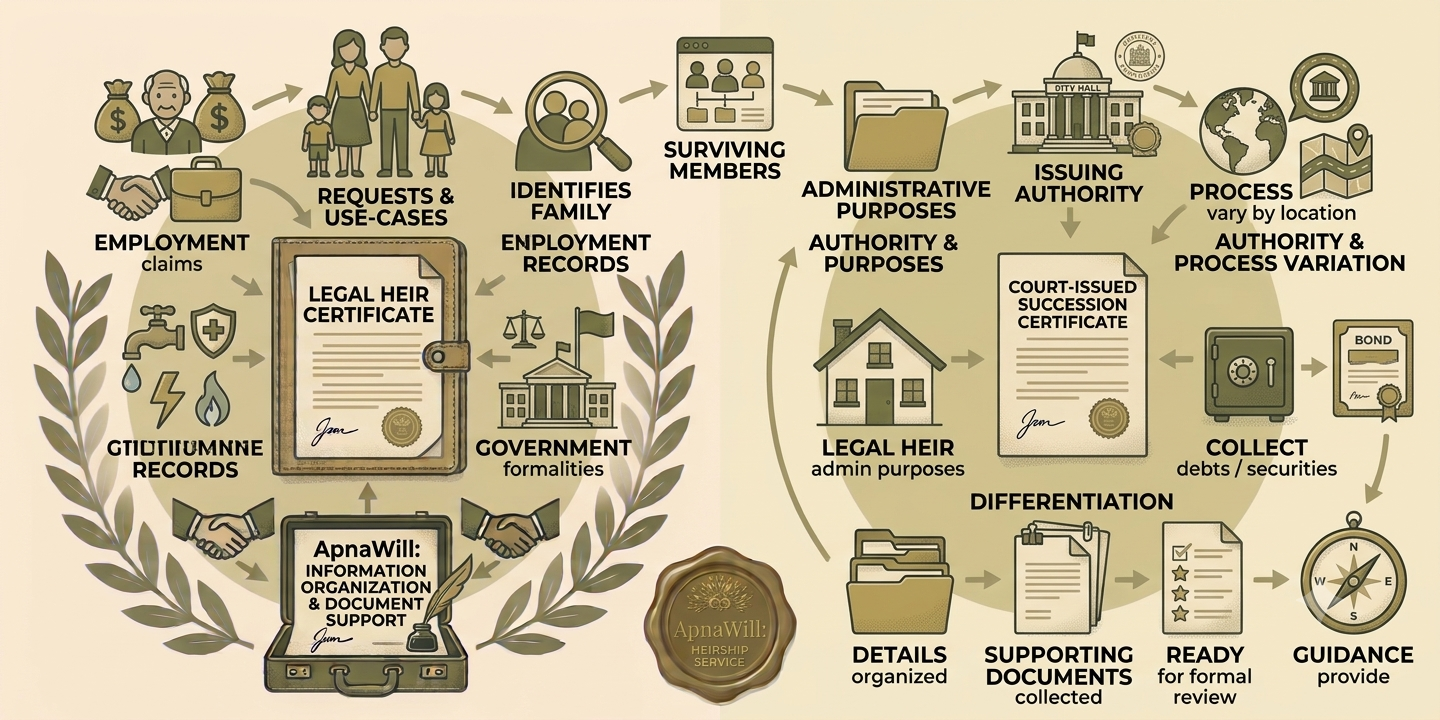
A Legal Heir Certificate identifies surviving family members of a person who has died for administrative purposes. It may be requested for pension or employment claims, insurance records, utility updates or certain government formalities. The issuing authority and process vary by location and by the institution making the request. It is different from a court-issued Succession Certificate, which may be needed to collect specified debts or securities. ApnaWill can help organise the details and supporting documents for review.
Enquiry form
Tell us where the deceased lived, who the surviving family members are, and which department or institution has requested proof of heirship. ApnaWill can follow up using the contact details you provide.
Legal Heir Certificate questions, answered.
Explore what the certificate may establish, who may apply, commonly requested records, and how it differs from a Succession Certificate. Issuing authorities and requirements can vary by location and purpose.
Ask ApnaWill ↗What does a Legal Heir Certificate establish?
It generally records the surviving family members and their relationship to the person who died for administrative purposes. The issuing authority, document name and scope can differ across States.
Which family members may be included in an application?
Depending on the applicable succession rules and local process, the certificate may list a spouse, children, parents or other eligible relatives. The authority may ask for details of all surviving family members.
When might an organisation ask for this certificate?
It may support requests involving pension or employment benefits, insurance, government records, utilities or certain revenue formalities. The institution handling the request decides which documents it will accept.
How is this different from a Succession Certificate?
A Legal Heir Certificate is commonly used as administrative proof of family relationships. A Succession Certificate is a court document that may authorise its holder to collect specified debts or securities. One document does not automatically replace the other.
Does every family need to obtain a Legal Heir Certificate?
No, it is not required in every situation. Whether it is needed depends on the department, institution, asset and local procedure involved. Check the requesting authority’s document list before applying.
What information and documents are usually requested?
Authorities may ask for the death certificate, applicant identity and address proof, relationship evidence, and details of surviving relatives. Additional records can be required, so confirm the checklist for the relevant location.
How long does an application take, and what does it cost?
Fees and processing times vary by location and authority. Verification, missing records or objections can affect timing. There is no single nationwide estimate that fits every application.
Can this certificate transfer property or release bank assets?
It may support some administrative record updates or property-related formalities, depending on local rules. It does not by itself settle every ownership dispute or guarantee release of financial assets; an institution may require a court order or other document.